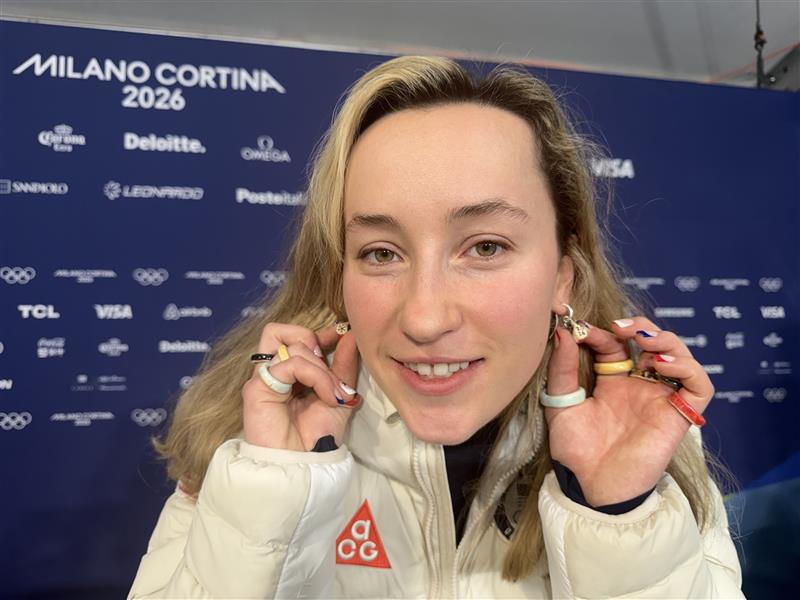
Her love affair with ceramics started at the age of six, about two years before dad James introduced her to sliding sports in Lake Placid, New York. He was a bobsledder for the United States Airforce in the 1970s. She was his only daughter.
When James got sick – diagnosis: Stage 4 prostate cancer – Kirkby watched him deteriorate, delivering important messages from his deathbed. About how much he loved her. And how her little brother Matthew should walk her down the aisle.
Pottery provided an escape. Something to distract her mind and busy her hands as she confronted a future without her father. ‘I was a big daddy’s girl,’ she said. James died last summer.
Kirkby still works with clay, having purchased an open studio membership at Arts Center Lake Placid, so she can fit craftsmanship around training with USA Luge. She and partner Chevonne Forgan will compete in the Olympic debut of women’s doubles luge Wednesday at the Cortina Sliding Centre. Along with equipment and cold weather gear, Kirkby brought about 100 ceramic pins to trade at the Winter Games, a fraction of the 2,000-plus she’s handmade since July.
She fancies herself ‘the MiCo ‘26 pin trading queen.’ What started as an outlet for her grief has blossomed into a dutiful enterprise. Each pin is stamped with the image of a women’s winter sport event or athlete (one exception being pins for Team Italy luger Dominik Fischnaller). Hilary Knight represents hockey. Kaysha Love and Elana Meyers Taylor represent bobsleigh. Mystique Ro represents skeleton. And Andrea Vötter and Marion Oberhofer of Italy represent doubles luge.
‘My sport is making its Olympic debut. How can I make the most of this moment to try and promote women’s sports?’ Kirkby said of the project’s origin. Having made ceramic gifts for family, friends and teammates most of her life, Kirkby also figured handcrafted mementos would prove most effective in advancing her cause.
‘Whenever I see someone again, someone I haven’t seen in maybe years, one of the first things they tell me is, ‘Oh, my God, I still have that cup you made me!’ … So this is definitely an item I can allow fans to have, and they aren’t going to forget. They will remember for years this item and how it affects them.’
Rabbi Alec Friedmann is another member of the Art Center’s open studio membership club. Like Kirkby, he found ceramics therapeutic. Fulfilling even.
He is the product of two German refugees who fled their home for South Africa, where he was later born, during the Holocaust. His mother was an artist. Father was a metal worker. Following in his footsteps, Friedmann went to college for mining engineering and metallurgy.
While in school, he ‘got the calling” and decided to become a rabbi.
‘Luck’ brought him to Lake Placid 33 years ago. After a stint as assistant to the president of Hebrew Union College, Friedmann started working as a chaplain for the New York State Department of Corrections. He did that for 20 years while also serving the Lake Placid Synagogue, which could only afford to take him on because he had another full-time gig. A dynamic, Freidmann said, that harkens back to rabbis of old. “They all had real jobs and did the rabbinic thing on the side.”
Freidmann started pottery at the Arts Center after retiring (or as he says, when one ‘take(s) off the old tires and put(s) on new ones’) from the Department of Corrections. It married his engineering background and his mother’s love of the arts perfectly. She worked with clay a lot, but never on a wheel.
After hearing about how Friedman used his 3D printer to replace a broken gear on the studio’s slab roller and to create a cutout for his kitchen tiles, Kirkby sought her own tool from him: A 3-by-4-inch cutout. She asked what he’d like in return. Just an espresso, he told her. Freidmann said, with a chuckle, he’s still waiting.
‘That just led to, ‘Well, can you do this?’ ‘Can you do that?’” Freidmann said. “And then she started thinking about the pins.”
Kirkby started her pin project at the end of July, rolling out slabs of clay, cutting out circles about the size of a silver dollar and stamping images of different sports onto them before firing. She gave Freidmann sketches of the art work, which he would take, reformat and upload to the CAD/CAM software used for 3D printing. The machine uses a thread of plastic 1.75 millimeters across to create whatever Freidmann asks it to. He said he can size the item within one hundredth of a millimeter.
The cutouts start about 29 millimeters, or just over an inch. After a bisque firing and a glaze firing, Freidmann said, they shrink to about six-sevenths of an inch.
Pins are like currency at the Olympic Games. They can be exchanged for favors, used in place of real money or traded like at Disney World. On top of bringing a few hundred with her, Kirkby is selling pins on Amazon as well as local Cortina and Lake Placid shops Art House, Sparkle Jewelry and Gifts, USA Spirit Shop and Mt Van Hoevenburg, where Kirkby trains. Ten percent of proceeds go directly to the athletes whose names and images Kirkby used, while the rest ‘pay off the material cost and the minimum wage that I paid myself,” she said.
‘She’s very entrepreneurial, which is something that I admire,” Freidmann said. ‘And it’s really been a joy to just be a little piece of her adventure.’
Reach USA TODAY Network sports reporter Payton Titus at ptitus@gannett.com, and follow her on X @petitus25.